How to make an AI shredder video that looks real
In short
A convincing AI shredder video gets four things right: believable scale, debris that matches the material, a camera that never moves, and a beat of stillness before the destruction starts.
None of those depend on the object being shredded, so fix them once and change only what goes in.
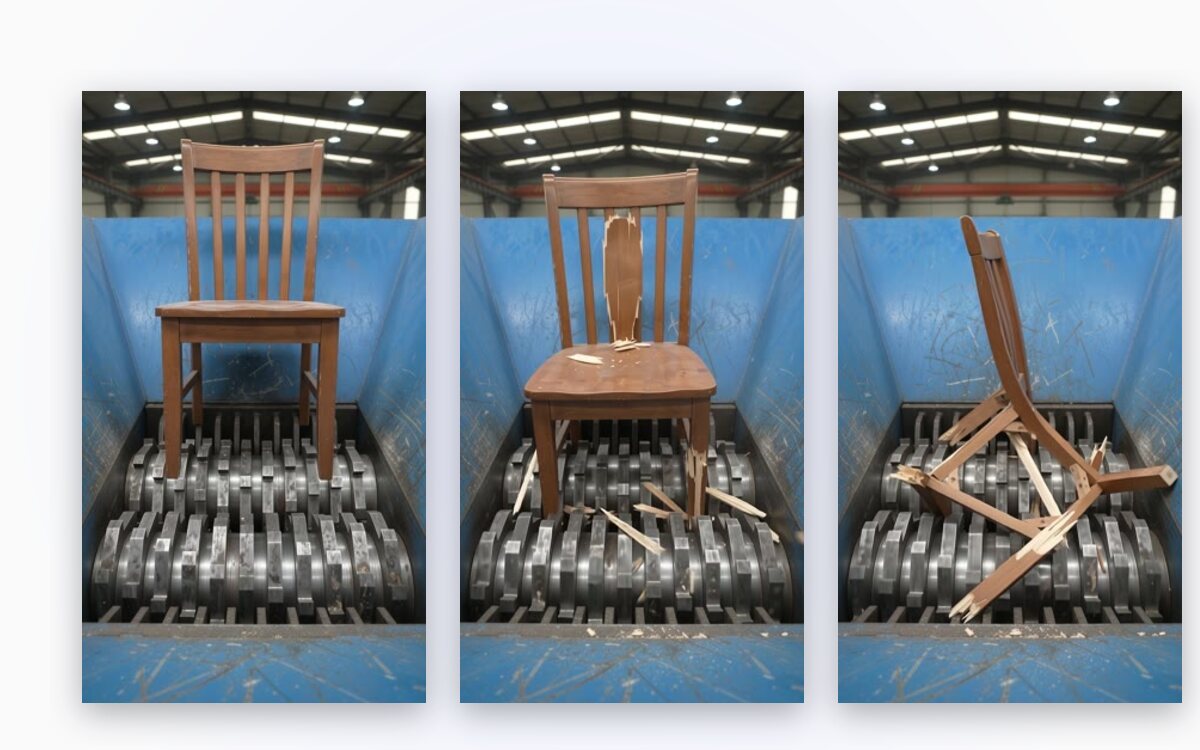
Industrial shredder clips have been one of the most reliable short-form formats for years, long before they could be generated. The appeal is simple and slightly unpleasant: you know what is about to happen, you watch it happen anyway, and it is over in ten seconds.
Generating them is now trivial. Generating a convincing one is not. The difference comes down to four things, and they are always the same four.
1. Scale has to be believable
The most common failure is an object that behaves like the wrong size. A wooden chair fed into a shredder should resist for a moment, then go suddenly. If it collapses like paper the illusion dies instantly, and no amount of visual detail rescues it, because the viewer is reading physics rather than pixels.
2. The debris has to match the material
Wood throws splinters and long pale shards. Plastic throws chips that tumble. Metal throws sparks and short fragments that fall fast. When the debris does not match what is being destroyed, the clip reads as fake even to someone who could not tell you why.
3. The camera should not move
Real footage of this kind comes from a fixed camera bolted above the machine. A drifting or orbiting camera signals rendering immediately. A locked frame is both more convincing and easier for the model, because it has one less thing to keep consistent.
4. The destruction needs a beginning
A clip that opens mid-shred has nowhere to go. The object should sit intact for a beat, so the viewer registers what it is and what is about to happen to it. That first beat is what makes the rest satisfying rather than merely loud.
What this means for the prompt
Most of that has nothing to do with the object being destroyed. Camera position, lighting, debris behaviour and pacing are constant across every shredder video worth watching, which makes them exactly the part you should not be rewriting each time.
Our shredder template fixes those four and leaves you the object. Change what goes in, and the machine, the camera and the physics stay where they were.
The honest caveat: no current model gets material physics right every time. What a tested prompt buys you is a much higher hit rate, not a guarantee.
Questions
Why do AI shredder videos look fake?
Usually the object behaves like the wrong size, the debris does not match the material, or the camera drifts. Viewers read the physics before the detail, so any one of those gives it away.
What camera angle works for a shredder video?
A locked overhead shot, the way real footage is filmed from a camera fixed above the machine. It is more convincing and easier for the model to keep consistent.
Will every generation come out right?
No. No current model gets material physics right every time. A tested prompt raises the share of usable runs; it does not guarantee one.